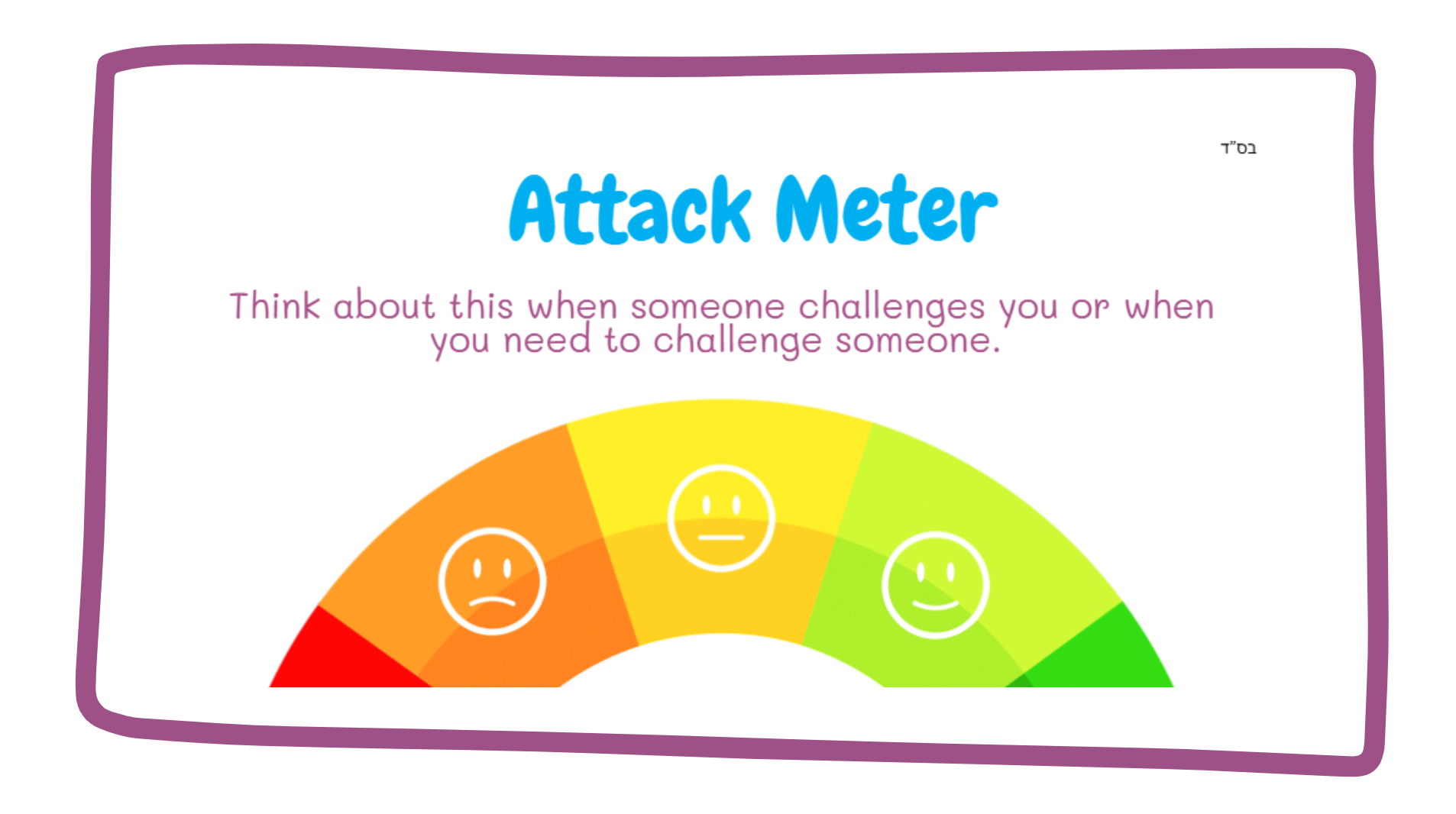
Teaching the “Attack Meter”
Conflict is an inevitable part of growing up, but it doesn’t have to be destructive. These handouts are designed to help children (ages 7-12) distinguish between attacking an idea and attacking a person. By using these tools, you are helping children build emotional intelligence and executive functioning skills that will serve them for a lifetime.
The Core Philosophy: Ideas vs. People
At the heart of these resources is a profound principle often shared by the Rebbe: “I do not speak about people; I speak about ideas” (איך רעדט נישט ועגן מענטשן, איך רעדט ועגן שיטות).
When guiding children through these activities, emphasize that:
- Productivity requires challenge: We don’t want to shy away from “attacking” or debating an idea if we think there is a better way to do things.
- Safety requires respect: The “Attack Meter” stays in the green when we focus on the logic, the plan, or the “what.” It moves into the red the moment we focus on the “who”.
1. The “Attack Meter” Visualization (Page 1)
Goal: To help children visualize the boundary between healthy debate and hurtful arguing.
- How to use it: Show the child the two lists. Have them identify which side feels like a “safe” place to be.
- The Discussion: Point out that the “Green Side” (Ideas) isn’t about being quiet or always agreeing—it’s about finding common ground and stating what you need. The “Red Side” (People) is where things become personal and hurtful.
2. Story for Reflection: “Harmony Beans” (Page 3)
Goal: To see the real-world consequences of personal attacks.
- How to use it: Read the story of Chaim and Shimon aloud.
- The Discussion: Ask the child at what point the argument stopped being about “decorating the cafe” and started being about “who is better”.
- Re-writing History: Ask, “If Chaim followed the Rebbe’s advice and only spoke about Shimon’s ideas instead of his personality, how might the cafe have stayed open?”
3. Practical Language: “I” vs. “You”
Goal: To provide concrete linguistic tools for staying on the “Idea” side of the meter.
- The Concept: “You” statements feel like a finger pointing in someone’s face. “I” statements feel like opening a door to your own needs.
- The Practice: Use the handouts to practice turning “You are bad/wrong” into “This is what I need”.
Tips for Success
- Model the Behavior: Next time you are frustrated with a student or child, use the “Idea focus” in real-time. Say, “I disagree with the way you are doing this task, but I think you are a great kid.”
- Validate the Passion: Remind children that it’s okay to feel strongly about their ideas! The goal isn’t to be less passionate; it’s to be more productive by keeping the personhood of others safe.